


Breadcrumb
Teachers Become Students Again Through Hands-On STEM Partnership at UCM’s Missouri Innovation Campus
By Alex Greenwood, July 14, 2026
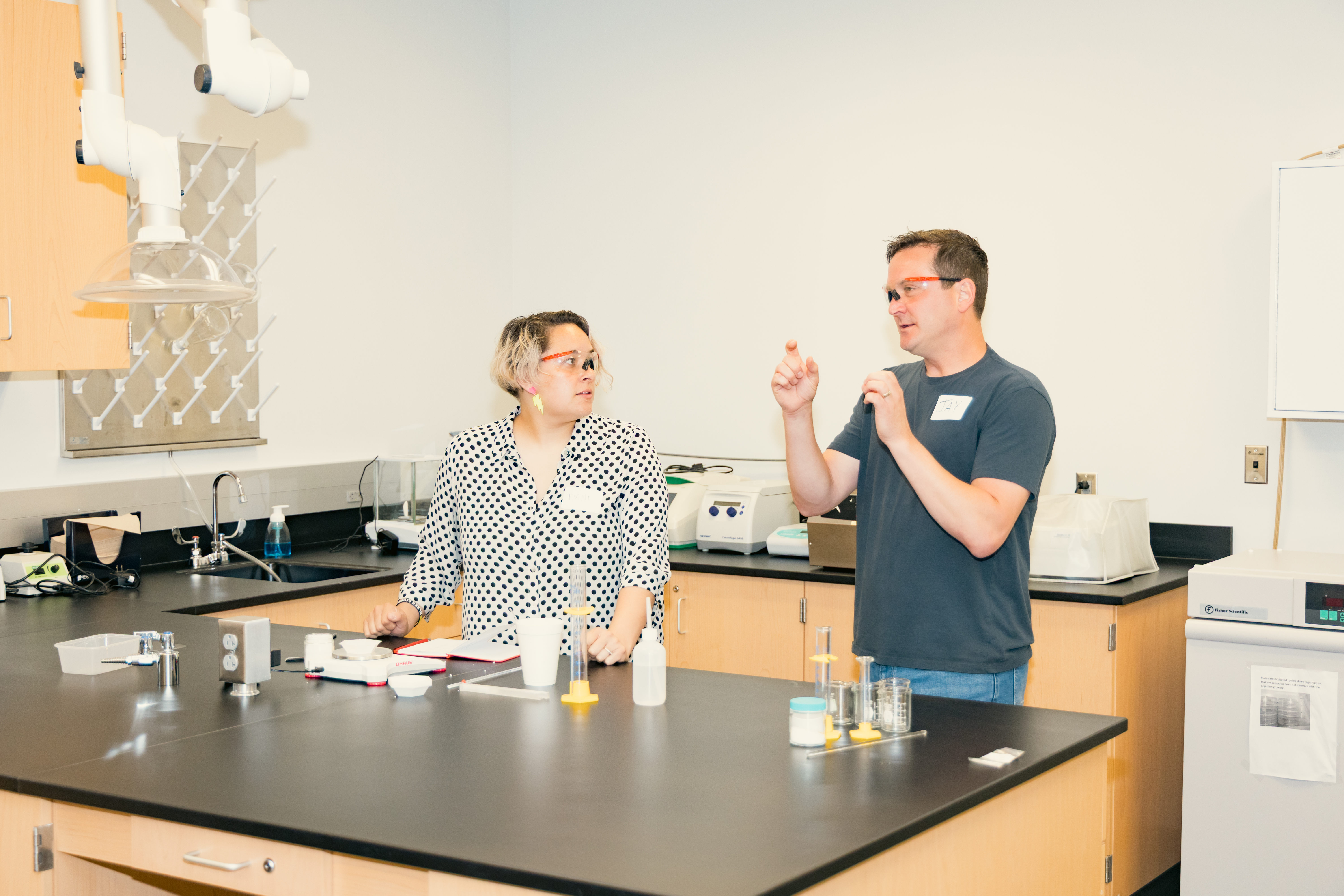
Jay Steinkruger, professor of chemistry at UCM, works through a chemistry experiment exercise with Dani Banion, a culinary and science teacher at Center Academy for Success in the Center School District, was among several educators from neighboring districts who attended professional development sessions are part of a growing partnership between UCM and the Lee's Summit R-7 School District.
On a sunny Monday morning, July 6, lab goggles replaced lesson plans as science teachers measured chemicals, recorded temperature changes and discussed classroom strategies in a chemistry lab at University of Central Missouri’s (UCM) Missouri Innovation Campus in Lee's Summit.
The teachers were not preparing for an exam. They were preparing for a new school year.
The hands-on professional development sessions are part of a growing partnership between UCM and the Lee's Summit R-7 School District, designed to equip educators with practical, classroom-ready lessons while strengthening connections between higher education and K-12 schools. More than 60 teachers participated in sessions during the four-day program at the Missouri Innovation Campus. The collaboration grew out of ongoing conversations among UCM faculty, school district leaders and curriculum specialists to develop professional learning opportunities based on the needs identified by classroom educators, with plans to expand participation across the Kansas City region.
Rather than spending the day listening to lectures, participants became students themselves, conducting experiments alongside UCM faculty, asking questions, analyzing results and discussing how the lessons could be adapted for classrooms ranging from introductory physical science to advanced chemistry.
“Our goal is to give teachers experiences and resources they can take directly back to their classrooms,” said Jay Steinkruger, professor of chemistry at UCM. “When educators leave with lessons they can immediately use and adapt for their own students, the impact extends far beyond the teachers participating in the workshop.”
Steinkruger led the chemistry sessions with Joshua Parham, assistant professor of chemistry at UCM. Together, they guided participants through laboratory exercises while discussing strategies for connecting science concepts to everyday experiences and adjusting lessons for different student skill levels. The sessions emphasized inquiry-based learning and practical activities teachers could readily adapt for their own classrooms.
"Our partnership with the University of Central Missouri creates meaningful opportunities for our teachers to learn from experts, collaborate with one another, and continue growing in their profession,” said Kristen Merrell, director of professional development for the Lee's Summit R-7 School District.
“Summer provides the time and space for meaningful reflection and professional learning, allowing teachers to return to their classrooms with fresh ideas, greater confidence, and practical strategies they can put into action right away. When we invest in our educators, the real winners are our students, who benefit from even stronger learning experiences every day," she added.
Throughout the session, instructors demonstrated how a simple experiment measuring the heat released as salts dissolve in water can be scaled for different grade levels and connected to familiar examples such as road de-icers, heat packs and self-heating food containers. The goal was to help students understand what happens during an experiment and why the science matters beyond the classroom.
Dani Banion, a culinary and science teacher at Center Academy for Success in the Center School District, was among several educators from neighboring districts who attended the sessions. For her, the experience offered both practical knowledge and reassurance.
“I have a culinary background and don’t have much of a science background, so I’m using this opportunity to build my prior knowledge,” Banion said. Now entering her second year of teaching, Banion said she arrived feeling intimidated.
“I thought, ‘Oh no, I don’t have a science background. I’m not going to understand these terms,’” she said. “But immediately they’re meeting you where you’re at. It’s great for all backgrounds.”
That supportive atmosphere stood out as faculty members circulated through the laboratory, answering questions while allowing participants to work through the experiments themselves.
“You don’t feel like you’re on an island trying to figure it out,” Banion said. “They’re walking around to check on you, but they’re also giving you the opportunity to work through it.”
Banion said the sessions are already shaping how she thinks about teaching science.
“I really liked learning through a phenomenon and then making a real-world connection,” she said. “It makes it that much more applicable and makes students more willing to engage with the material.”
Just as important, she said, the activities are practical enough to take back to her own classroom.
“That experiment alone was exciting because I realized how simple it was,” Banion said. “It didn’t require a ton of materials. It’s just stuff you can get from the grocery store.”
The science workshops were intentionally small, allowing participants to spend time in the laboratory conducting experiments rather than simply observing demonstrations. Other sessions during the week addressed broader instructional topics, including biology, mathematics, physics and the use of artificial intelligence in teaching and learning. Scheduled lunches also gave participants time to exchange classroom ideas, discuss challenges and build professional relationships with colleagues and UCM faculty.
The initiative reflects UCM's ongoing commitment to supporting educators beyond graduation by sharing faculty expertise, campus facilities and instructional resources with school districts throughout the region. Organizers hope the collaboration will continue to grow, strengthening partnerships between UCM and K-12 educators while bringing new classroom-ready ideas to teachers across the Kansas City metropolitan area.
As teachers packed up notebooks and lab materials Monday afternoon, they left with more than data collected during the day’s experiments. They returned to their schools with new classroom activities, renewed confidence and fresh ideas for helping students see science not simply as a collection of facts, but as a way of understanding the world around them.
For more information about UCM's Department of Physical Sciences, visit ucmo.edu/physical-sciences or call 660-543-4432. The department offers career-focused undergraduate programs that prepare students for careers in fields including forensic science, food safety, health care and other science-related professions while developing critical thinking, communication and problem-solving skills valued by employers.


